In Mississippian Art the Falcon Is Generally Associated With
Warfare affected the lives of Georgia's Indians in many pregnant means. All Indian men considered themselves warriors and trained to use the bow and war gild. Valor in battle, demonstrated through the killing of enemies, was a chief means of social advancement every bit recently as the nineteenth century. Warfare also became a prominent theme in the Indians' conventionalities systems and greatly afflicted the evolution and organization of their societies.
Significant warfare offset began to develop among Georgia Indians in the Mississippian Period (A.D. 800-1600), a time when relatively big societies called chiefdoms evolved throughout southeastern Northward America. During this period defensive fortifications were starting time congenital effectually some towns. These included log palisades that completely encircled big towns such as the one at the Etowah Mounds in north Georgia. Palisades were often plastered with clay to continue them from being ignited by burning arrows. Sometimes they incorporated defensive towers (bastions) that allowed archers to shoot at enemies who got close to the wall. Ditches similar to moats were also dug around some palisades and were part of the fortifications of both the Etowah site and the Ocmulgee site at Macon.
Weapons
Bows and arrows were widely used in Indian warfare beginning in the Late Woodland or Early Mississippian Period. Warriors used a thick D-shaped simple bow fabricated from hickory, ash, or black locust that was 50 to sixty inches in length and had a pull weight of near fifty pounds. These bows could send arrows long distances and were typically used to shoot at enemy villages or units of warriors at a distance.
War clubs also came into meaning use during the Mississippian Period. They were carved from a hardwood such every bit hickory and were usually nearly i-and-a-half to 2 feet long, although some may have reached 3 anxiety in length. In that location were several types, the most common class beingness the atassa, which was actually a wooden sword shaped like a pirate'south cutlass. Other common types were the earth-headed order, which had a three-inch spherical knob at the end of a slightly curved handle, and the tomahawk, a rock axe head attached to a wooden handle.
War clubs were the preferred combat weapon because Indian warriors could heighten their social status by killing enemies in single combat. They were widely depicted in Mississippian Period art in clan with images and symbols of warfare. In historic Creek and Cherokee myths they were associated with the Lightning or Thunder deity, sometimes in the form of a falcon.
Chiefs and warriors possessed ceremonial forms of state of war clubs that incorporated symbols of the Sun and Thunder deities and served equally markers of their formalism status. These were made entirely from rock that had been chipped or ground into the desired shape, or alternatively, were tomahawks that had copper heads affixed to wooden handles.
Mississippian Menstruum Warfare
Warriors honed their archery and warclub skills through lifelong preparation. According to early historical accounts, they demonstrated impressive skill in using war clubs and were favorably compared to European fencing masters. The warriors likewise played a lacrosse-type sport chosen "the ball game" in which they employed war gild–sized ball sticks reminiscent of combat with war clubs.
The most common type of warfare was a raid carried out by a modest grouping of men; a raiding political party would surreptitiously enter an enemy chiefdom's territory to set on unsuspecting households or ambush people. Warriors typically used state of war clubs in these raids. Trophies from the victims, such as scalps, were taken to prove their success in the come across. In many Indian cultures the killing of ane's kinsman by an enemy necessitated reprisal. This could result in long-term, chronic raiding between enemy chiefdoms as each side in turn sought revenge on the other.
Historical accounts from the sixteenth and seventeenth centuries also describe a few large-scale battles betwixt the armies of enemy chiefdoms. Each army consisted of a few hundred men arranged in a germination, with the chief acting as overall commander. They would shoot their arrows at one another until the supply was expended; then they would engage in mitt-to-hand combat with war clubs.
Historic Period Warfare
Warfare inverse dramatically during the eighteenth and nineteenth centuries as a consequence of European inroad. Iron hatchets were extensively introduced in the early eighteenth century and began to supplant war clubs. By the latter part of this century metallic tomahawks were existence made specifically for the Indian trade. Firearms had likewise been introduced.
Periodic raiding and some pitched battles continued betwixt the Creek and Cherokee Indians in the Historic period. Past the late eighteenth and nineteenth centuries, both the Creeks and Cherokees faced increased military threats from white settlers who were able to heighten large civilian militias equipped with firearms to reinforce military machine troops. The Indians were forced to cope with highly organized raids and battles with whites who had superior troops and equipment. The Indians adopted new military machine tactics, including larger armies to fight some pitched battles and guerrilla-way maneuvers. In some cases Indian communities erected forts styled subsequently those of the whites. Ultimately, even so, the Indians were unable to win against the superior numbers of well-armed American forces and were forcibly exiled to Oklahoma in the early nineteenth century.
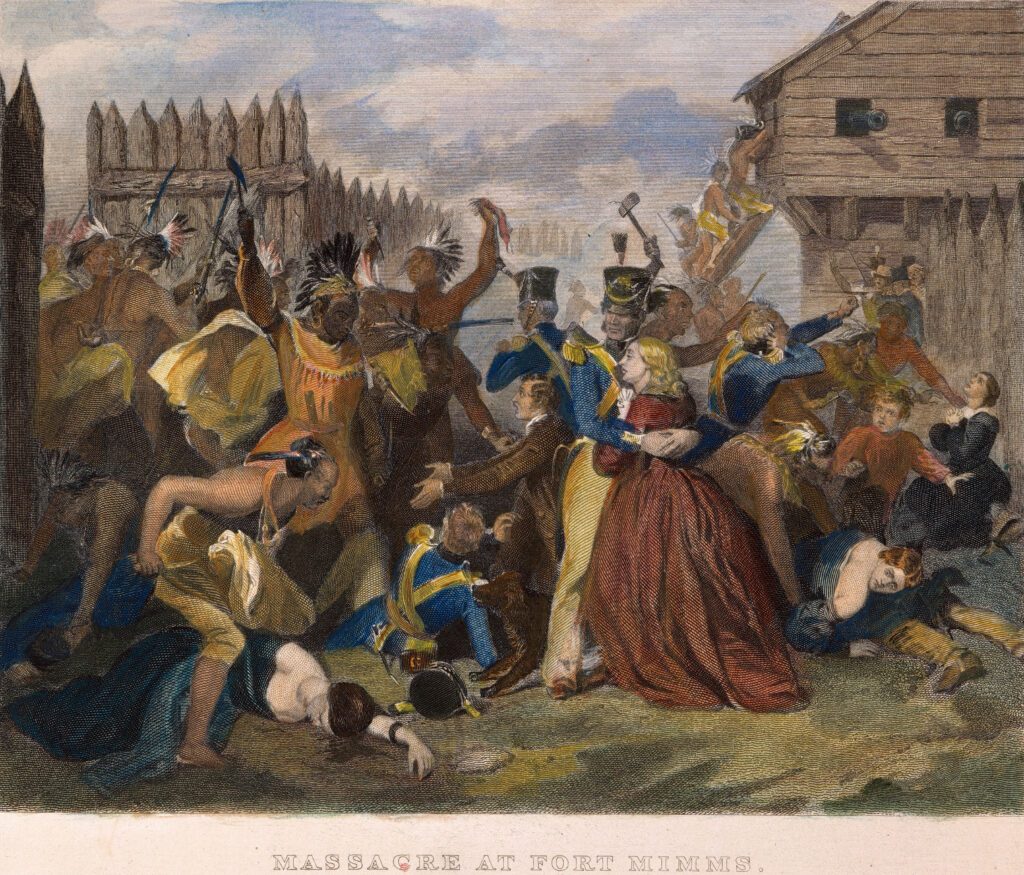
Reprinted by permission of The Granger Collection, New York
Source: https://www.georgiaencyclopedia.org/articles/history-archaeology/indian-warfare/

إرسال تعليق for "In Mississippian Art the Falcon Is Generally Associated With"